


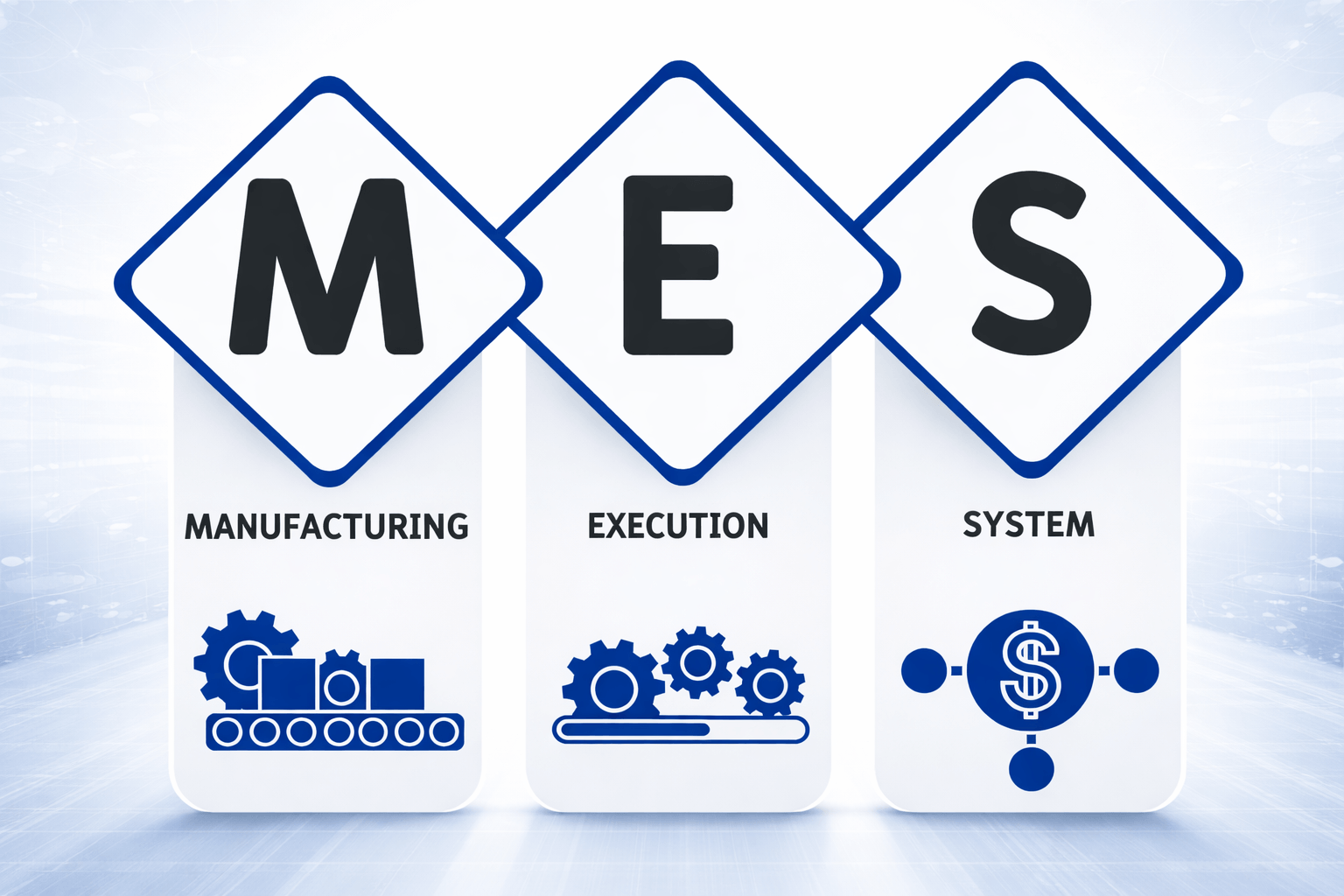
MES – Manufacturing Execution System – is used in factories to monitor, supervise, control production systems, and store complex data. MES ensures efficient production operations and improves labor productivity. In this article, we invite you to learn about MES systems in manufacturing and how to effectively apply them in production plants.
1. What is an MES in Manufacturing?
MES (Manufacturing Execution System) is a software solution used in manufacturing operations management. It provides functions for production control, job dispatching, and acts as a data collection system for production processes, productivity, material management, and work-in-progress status. At the same time, it delivers real-time insights that help managers understand the operational status of the factory.
MES operates as an intermediate system between Enterprise Resource Planning (ERP) systems and Supervisory Control and Data Acquisition (SCADA) or other process control systems.
Therefore, an MES system enables decision-makers to access fast, detailed data about the entire factory’s operations, allowing them to make more informed and optimized production decisions.
2. Core Functions of an MES System
A standard MES system is expected to provide 11 core functions (according to the MESA model), which can be grouped into four main functional areas: production operations management, resource management, equipment management, and product information management.
2.1. Production Operations Management
This group includes functions such as production execution planning and resource allocation for implementing production plans. The goal is to ensure that production data is accurate, consistent, and continuously updated—thereby increasing productivity and eliminating risks caused by missing or inconsistent information across departments and production stages.
2.2. Production Resource Management
This includes functions that identify and track the status of factory resources and how they are utilized during production, including raw materials, work-in-progress items, and human resources.
2.3. Product Information Management
This function enables tracking of product data and genealogy (traceability), while providing tools for quality management. Quality management may exist as a module within the MES system or as a standalone solution integrated into MES.
2.4. Equipment Management
This function allows analysis of overall equipment effectiveness (OEE), supports maintenance planning to reduce downtime and production interruptions, and focuses on collecting data from machines and production activities.
3. Four Key Benefits of MES Systems
Globally, investment in MES accounts for approximately 21%–25% of total spending on manufacturing process optimization, compared to 17%–19% for ERP systems. Without MES, ERP systems may not operate effectively due to the lack of real-time and detailed data. This highlights the reliability and practical value of MES.
3.1. Ensures Optimized and Continuous Production
- Maintains consistent and well-structured production plans
- Improves planning efficiency through standardized processes
- Enables continuous monitoring and control of production
- Reduces lead time and minimizes downtime through optimized planning
3.2. Optimizes Equipment and Production Resources
- Reduces manual work and paperwork, improving information flow
- Enhances machine performance and operational efficiency
- Optimizes resource utilization through data analysis (labor, energy, equipment, and change requests)
- Improves responsiveness to time-sensitive and priority-based tasks
3.3. Enhances Coordination and Process Improvement
- Improves internal collaboration with real-time visibility of work status
- Reduces operational risks through timely communication of work instructions
- Ensures compliance with regulatory requirements through production records
- Identifies bottlenecks and enables faster resolution through process performance analysis
3.4. Improves Product Quality and Data Reliability
- Identifies root causes of quality issues using statistical process control
- Provides early warnings and reduces quality risks through machine sensor data collection and alerts
- Stores and generates detailed, consistent production data for analysis and forecasting

4. Should Businesses Implement MES in Manufacturing?
In practice, there is no strict standard to determine whether a business should or should not implement an MES in its production process. However, from the perspective of the benefits and capabilities that an MES system provides, any company involved in manufacturing products should consider adopting MES to optimize operations, shorten production cycles, maintain product quality, and enhance competitiveness.
In addition, businesses with one or more of the following characteristics tend to gain even greater benefits from MES implementation (the more characteristics present, the greater the benefits):
- Labor-intensive operations
- Outsourced or contract manufacturing activities
- Mass production environments
- Large-scale production (multiple factories, extensive machinery, and a large workforce)
5. How to Effectively Implement MES in Manufacturing
A common question among manufacturers is: How can we effectively apply MES in our business? Below are key recommendations to help answer that question:
Choose a Reliable Solution Provider
To successfully implement MES with long-term scalability and upgrade potential, businesses need a trusted partner with strong technological expertise, industry experience, and a clear strategic vision.
Focus on System Security
MES should provide a closed-loop system to prevent unnecessary data leakage, while enabling traceability and historical data storage for effective monitoring and risk control.
Design a User-Friendly and Flexible Interface
A well-structured, intuitive user interface—along with flexible access (e.g., mobile devices)—plays a crucial role in successful MES adoption. Ease of use ensures higher user acceptance and operational efficiency.
Integrate Advanced Data Technologies
MES implementation can be enhanced by integrating advanced technologies such as AI and Machine Learning. These technologies improve data processing capabilities and help transform raw production data into valuable insights, enabling continuous innovation.
Ensure Scalability for Future Growth
Investing in a scalable MES system is essential for companies with long-term growth ambitions. The system should support integration with satellite applications, sensors, and full connectivity with ERP systems to maximize operational efficiency.
Plan and Execute Implementation Strategically
Finally, but most importantly, businesses should take action by developing a clear and structured plan to deploy MES across their factories.
Chí Thanh E&C is committed to accompanying businesses on their journey to successfully implement MES in manufacturing. With extensive consulting experience and strong IT capabilities, the company delivers customized MES solutions tailored to each enterprise’s strategy, needs, and production characteristics—while ensuring alignment with industry-specific requirements.